
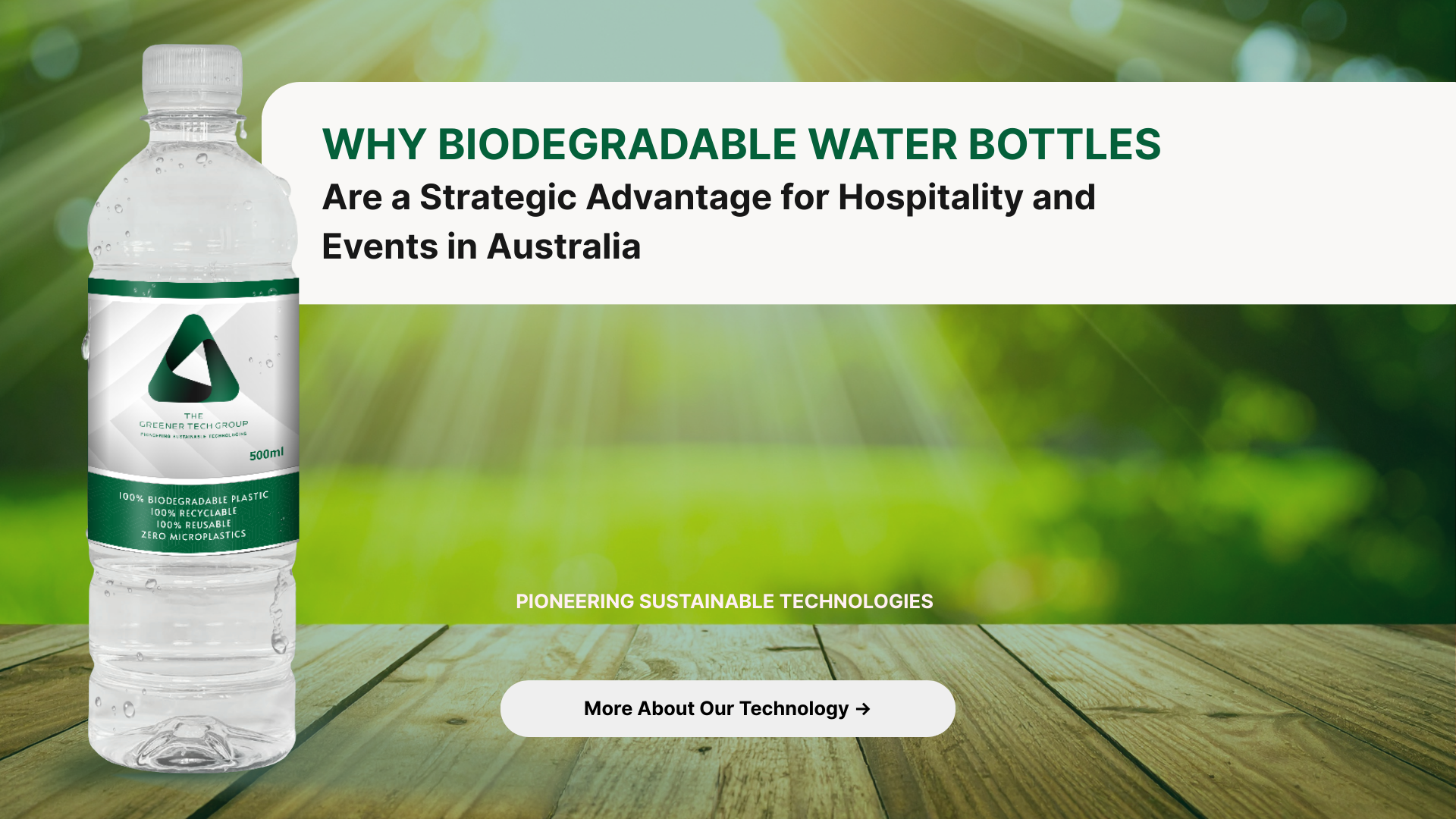
Why Biodegradable Water Bottles Are a Strategic Advantage for Hospitality and Events in Australia
Australia’s hospitality and events sector is undergoing a structural shift. Venues, festivals, hotels, stadiums and large scale event organisers are no longer judged only on service quality or experience. Environmental performance has become a core expectation. Plastic waste, particularly single use bottled water, now sits at the centre of public scrutiny, regulatory attention and corporate sustainability reporting.
For many years bottled water was considered a practical necessity for hospitality and events. It is portable, safe, familiar and widely accepted by consumers. However scientific research, government data and global regulatory frameworks now show that conventional plastic bottles create long term environmental and health risks that cannot be ignored. As a result, biodegradable water bottles are emerging as a strategic advantage rather than a niche sustainability option.
This article explains why biodegradable water bottles are becoming essential for Australian hospitality and events. It draws on verified scientific studies, Australian government data and international regulatory developments to show how this shift supports compliance, risk management, brand trust and operational resilience.
The plastic challenge facing hospitality and events
Hospitality and events generate concentrated volumes of plastic waste in short periods of time. A single music festival or sporting event can distribute tens of thousands of bottled water units in a single day. Hotels and venues also rely heavily on bottled water for guest rooms, conferences and catering.
According to Australian government reporting, more than 4 million tonnes of plastic products and packaging were consumed nationally in 2023 to 2024. A large proportion of this volume came from packaging used in food service and beverages. Recycling rates for plastic bottles remain limited and contamination is common. Most plastic ultimately enters landfill where it fragments over time into microplastics.
This creates reputational and operational risks for hospitality operators. Visible waste accumulation at events attracts public criticism. Landfill reliance conflicts with sustainability commitments. Corporate clients increasingly request evidence of environmental performance before booking venues or sponsoring events.
In this context, packaging choices are no longer neutral. They influence compliance, perception and long term cost.
Scientific evidence linking plastic bottles to microplastic exposure
The case for safer bottled water packaging is supported by medical research. In 2024 the New England Journal of Medicine published a study identifying microplastics in human arteries. Patients with higher concentrations showed increased risk of cardiovascular events. This finding confirms that plastic particles are not confined to the environment. They enter the human body and interact with critical biological systems.
Additional research conducted by Columbia University and the National Institutes of Health analysed bottled water sold globally. The study found an average of 240 thousand plastic particles per litre. Many of these particles were nanoplastics capable of crossing biological membranes. This research demonstrates that bottled water itself can be a direct exposure pathway for plastic particles.
For hospitality and events, this evidence changes the risk profile of conventional bottled water. Venues are responsible not only for waste generation but also for providing products that may contribute to long term exposure concerns. While regulation has not yet banned plastic bottles, scientific evidence is shaping future standards and expectations.
Regulatory pressure is increasing across Australia
Australian regulation is evolving in response to plastic waste and environmental health concerns. The National Plastics Plan sets targets for waste reduction, improved material recovery and increased accountability across supply chains. While bottled water is not yet restricted nationwide, state and local governments are increasingly introducing bans or restrictions on single use plastics in public venues and events.
Councils now require waste management plans for major events. These plans often prioritise reduction of plastic waste at the source. Hospitality operators seeking permits must demonstrate compliance with environmental conditions. Failure to do so can result in higher costs, delayed approvals or reputational damage.
In parallel, sustainability reporting frameworks are becoming more influential. Corporate clients, sponsors and international partners increasingly expect venues and event organisers to align with environmental social governance standards. Packaging choices, including bottled water, are now assessed as part of these frameworks.
Biodegradable water bottles allow hospitality operators to demonstrate proactive compliance rather than reactive adjustment.
Global frameworks are reshaping expectations
Australia does not operate in isolation. Global regulatory systems are influencing packaging requirements across borders.
The European Union Digital Product Passport will require detailed material data for products entering the EU market. While this system initially focuses on specific sectors, it sets a precedent for traceability and material verification. Packaging materials must demonstrate environmental performance, sourcing transparency and end of life behaviour.
The United Nations Environment Programme is advancing a global treaty on plastic pollution. Draft frameworks emphasise reduction of plastic production, control of additives and improved material accountability. Hospitality and events operating internationally or hosting global sponsors must anticipate these changes.
For Australian venues hosting international events or working with global brands, alignment with verified packaging standards is becoming a competitive necessity.
Why biodegradable water bottles change the equation
Biodegradable water bottles offer a fundamentally different risk profile compared to conventional plastic bottles. When properly certified and verified, these bottles maintain the functional benefits of plastic while addressing long term environmental impact.
Verified biodegradable bottles are designed to break down fully under appropriate conditions without producing microplastics or toxic residues. This is a critical distinction. Fragmentable plastics that break into smaller pieces do not solve the pollution problem. True biodegradation removes the material from the environment entirely.
For hospitality and events, this means bottled water can remain part of service delivery without contributing to persistent plastic accumulation. Waste management becomes simpler. Environmental impact is reduced. Compliance with sustainability commitments becomes demonstrable.
Strategic advantages for hospitality and events
Compliance and approvals
Using biodegradable water bottles simplifies approval processes for councils and regulators. Event applications that include verified biodegradable packaging demonstrate proactive risk management. This can reduce negotiation time and compliance costs.
Brand trust and reputation
Consumers are increasingly aware of plastic pollution and microplastic research. Visible use of biodegradable bottles signals responsibility and credibility. This is particularly important for premium venues, festivals and corporate events where brand alignment matters.
Alignment with corporate clients
Many corporate clients now require environmental performance data from venues and suppliers. Biodegradable bottled water supports these requirements without forcing clients to compromise on convenience or safety.
Waste management efficiency
Events generate waste in concentrated volumes. Biodegradable bottles reduce long term landfill burden and simplify post event clean up. They also align with composting and organic waste streams where permitted.
Future proofing operations
As regulation tightens, operators who adopt safer packaging early avoid rushed transitions later. Biodegradable water bottles provide resilience against future bans, reporting requirements and supply chain disruptions.
The importance of verification and certification
Not all biodegradable bottles meet scientific standards. CSIRO research highlights widespread confusion around bioplastic labelling in Australia. Some products marketed as biodegradable do not fully break down or require industrial conditions that are rarely met.
For hospitality and events, verification is essential. Packaging should be supported by independent testing, clear certification and transparent data. Material verification programs provide confidence that environmental claims are accurate and defensible.
The Greener Tech Group positions itself within this verification driven approach. Its biodegradable water bottle technology is designed to meet strict scientific criteria for breakdown without microplastic residue. This distinction is critical for venues seeking credible solutions rather than marketing claims.
Cost considerations and commercial reality
Cost remains a factor for hospitality operators. Biodegradable bottles may have a higher unit price than conventional plastic. However this must be assessed against total cost of ownership.
Compliance costs, waste management fees, reputational risk and future regulatory adaptation all carry financial implications. When these factors are considered, biodegradable water bottles often represent a cost neutral or cost positive decision over time.
Large scale events also benefit from volume pricing and sponsorship opportunities tied to sustainability outcomes. Brands increasingly seek association with environmentally responsible events and venues.
The future outlook for hospitality and events
The direction is clear. Plastic reduction expectations will continue to rise. Scientific evidence on microplastics will inform policy. Global frameworks will demand transparency. Hospitality and events that fail to adapt will face increasing pressure.
Biodegradable water bottles are not a symbolic gesture. They are a practical response to verified environmental and health challenges. For Australian hospitality and events, they represent a strategic advantage that supports compliance, reputation and long term viability.
Conclusion
Australia’s hospitality and events sector is at a turning point. Bottled water remains a service necessity, but conventional plastic bottles are no longer aligned with scientific evidence or regulatory direction. Biodegradable water bottles provide a credible pathway forward.
By adopting verified biodegradable packaging, venues and event organisers can reduce environmental impact, protect brand trust, meet compliance requirements and prepare for future regulation. This is not simply about sustainability messaging. It is about risk management, operational resilience and responsible leadership.
For hospitality and events in Australia, biodegradable water bottles are becoming a strategic standard rather than an optional extra.
Key Summary
• Hospitality and events generate concentrated plastic waste from bottled water
• Scientific studies confirm microplastics in bottled water and human arteries
• Australian and global regulation is moving toward stricter material accountability
• Biodegradable water bottles reduce long term environmental and compliance risk
• Verified certification is essential to avoid misleading claims
• Adoption supports brand trust, approvals and future readiness
• Biodegradable bottled water offers a strategic advantage for Australian venues
References:
AUSTRALIAN GOVERNMENT. Department of Climate Change, Energy, the Environment and Water.
Australian Plastics Flows and Fates Reporting 2023 to 2024. Canberra: DCCEEW, 2024. Available at: https://www.dcceew.gov.au/environment/protection/waste/plastics-and-packaging/australian-plastic-flows-fates-reporting. Accessed on: 18 Dec. 2025.
AUSTRALIAN GOVERNMENT. Department of Climate Change, Energy, the Environment and Water.
National Plastics Plan 2021. Canberra: DCCEEW, 2021. Available at: https://www.dcceew.gov.au/environment/protection/waste/plastics-and-packaging/national-plastics-plan. Accessed on: 18 Dec. 2025.
CSIRO. Commonwealth Scientific and Industrial Research Organisation.
The State of Bioplastics in Australia. Canberra: CSIRO, 2024. Available at: https://www.csiro.au/en/news/all/news/2024/december/csiro-report-reveals-the-state-of-bioplastics-in-australia. Accessed on: 18 Dec. 2025.
THE NEW ENGLAND JOURNAL OF MEDICINE.
Microplastics and Nanoplastics in Human Arteries. Massachusetts: NEJM, 2024. Available at: https://www.nejm.org. Accessed on: 18 Dec. 2025.
COLUMBIA UNIVERSITY; NATIONAL INSTITUTES OF HEALTH.
Nanoplastics in Bottled Water. New York: Columbia University, 2024. Available at: https://www.nih.gov. Accessed on: 18 Dec. 2025.
EUROPEAN COMMISSION.
Digital Product Passport Initiative. Brussels: European Commission, 2024. Available at: https://ec.europa.eu. Accessed on: 18 Dec. 2025.
UNITED NATIONS ENVIRONMENT PROGRAMME.
Global Treaty on Plastic Pollution. Nairobi: UNEP, 2024. Available at: https://www.unep.org. Accessed on: 18 Dec. 2025.
ORGANISATION FOR ECONOMIC CO OPERATION AND DEVELOPMENT.
Global Plastics Outlook Economic Drivers Environmental Impacts and Policy Options. Paris: OECD Publishing, 2022. Available at: https://www.oecd.org/environment/plastics. Accessed on: 18 Dec. 2025.