
Australia is moving decisively toward one of its most significant environmental reforms in decades. By 2026 a wide range of hard to recycle plastic items will be banned nationwide. These changes are not symbolic gestures. They represent a fundamental shift in how packaging is evaluated, approved and permitted to enter the Australian market.
The bans respond to growing landfill pressure, mounting evidence of microplastic pollution and the clear failure of recycling systems to manage certain plastic products. For manufacturers, importers, hospitality operators and event organisers, the implications are substantial. Packaging choices that were once accepted as standard will soon be non compliant.
This article examines what Australia is banning, why these changes are occurring, how state and federal policy is aligning, and what role verified biodegradable and enzyme based packaging solutions can play in meeting the new regulatory landscape.
What Australia is banning and why
In December 2025, national reporting confirmed that Australia will phase out hard to recycle plastics by 2026. The bans are guided by the National Roadmap for Problematic and Unnecessary Plastics, which identifies 24 plastic items for elimination. These items share common characteristics. They are small, lightweight, frequently contaminated and not practically recyclable at scale.
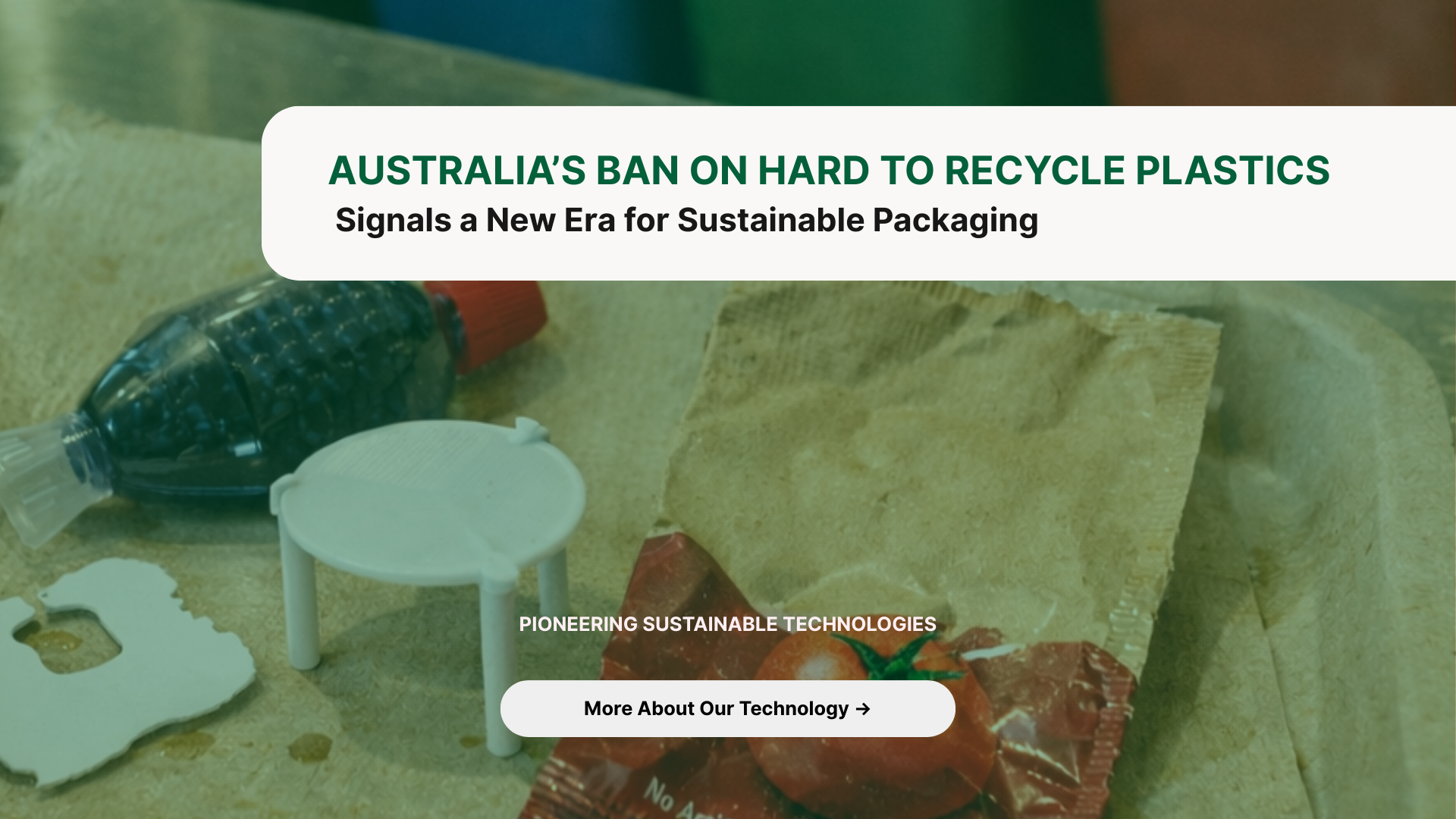
Examples include soy sauce fish bottles, bread tags and pizza savers. While individually small, these items appear in very high volumes across food service, retail and hospitality. Once discarded they are rarely recovered. Instead they enter landfill or escape into the environment where they fragment over time.
In New South Wales alone more than 800000 tonnes of plastic waste has entered landfill in recent reporting periods. A significant proportion of this waste consists of materials that recycling systems were never designed to handle. Fragmentation of these plastics contributes directly to microplastic accumulation in soil and water.
The policy objective is clear. Australia is shifting away from managing plastic waste after it is created and instead preventing problematic materials from entering the system in the first place.
State action is accelerating ahead of 2026
While the national roadmap provides direction, states are already implementing their own bans. South Australia has confirmed that soy sauce bottles under 30 millilitres will be banned from September 2025. Other states are expected to introduce similar measures as national coordination increases.
This creates immediate implications for businesses operating across multiple jurisdictions. Packaging that remains legal in one state may be banned in another. For importers and distributors this raises compliance risk, logistical complexity and potential financial loss.
The trend is clear. Waiting until 2026 to adapt is not a viable strategy. Early compliance is becoming essential for continuity of operations.
Why hard to recycle plastics are being targeted
Hard to recycle plastics are not targeted arbitrarily. They represent a disproportionate environmental risk relative to their utility.
Small items are easily lost during waste collection and processing. Once exposed to sunlight, heat and mechanical stress they fragment into microplastics. These particles persist in the environment and accumulate over time.
Scientific research has confirmed that microplastics are no longer confined to ecosystems. In 2024 the New England Journal of Medicine published evidence of microplastics in human arteries, with higher concentrations associated with increased cardiovascular risk. This research reinforces the importance of reducing environmental exposure pathways wherever possible.
Banning items that fragment easily and evade recovery systems is a preventative strategy grounded in environmental and health science.
Sustainable alternatives are already emerging
The phase out of problematic plastics is not occurring in isolation. Industry has already begun developing alternatives.
In New South Wales, Masterfoods introduced a paper based tomato sauce packet to replace traditional plastic sachets. This change is expected to save approximately 190 tonnes of plastic annually. While not every alternative will be suitable for every application, this example demonstrates that functional replacements are achievable.
However the transition also highlights a critical issue. Not all alternatives deliver genuine environmental benefits. Some paper based products rely on plastic linings. Others introduce contamination challenges or higher lifecycle emissions.
This is why regulators and scientific bodies are increasingly emphasising material verification rather than material substitution alone.
The rise of material verification in packaging regulation
Australia’s bans signal a broader change in regulatory expectations. Packaging will no longer be assessed primarily on recyclability claims. Instead, regulators are moving toward verified environmental performance.
Material verification involves independent scientific assessment of how a material behaves across its entire lifecycle. This includes chemical composition, durability during use, behaviour in landfill, potential to generate microplastics and the toxicity of breakdown byproducts.
CSIRO research has identified widespread confusion around biodegradable and bioplastic claims in Australia. Products labelled as biodegradable may not meet accepted scientific definitions. Without verification, these products risk perpetuating environmental harm under the guise of sustainability.
As bans expand, businesses will need to demonstrate that replacement materials genuinely solve the problem rather than shift it elsewhere.
The Eco Bottle and enzyme based plastic solutions as part of the transition
As Australia moves toward banning hard to recycle plastics by 2026, attention is shifting to technologies that address the environmental behaviour of plastic itself. One example is The Eco Bottle, a biodegradable bottled water solution that integrates enzyme based technology designed to alter plastic behaviour at end of life.
Conventional plastic bottles are engineered for durability. While this is beneficial during use, it becomes a long term environmental liability once the bottle is discarded. Traditional plastics fragment into microplastics that persist in landfill, soil and waterways.
The Eco Bottle incorporates an embedded enzyme that remains inactive during the product’s use phase. Once the bottle enters suitable disposal environments such as landfill and is exposed to moisture and heat, the enzyme activates. It begins breaking down the polymer structure at a molecular level, enabling full biodegradation rather than fragmentation into microplastics.
This approach aligns closely with the intent of Australia’s National Roadmap for Problematic and Unnecessary Plastics. The roadmap prioritises the removal of materials that cannot demonstrate safe end of life outcomes. Enzyme based biodegradable plastics provide a pathway for retaining essential packaging formats while reducing long term environmental impact.
For hospitality, events and large scale distribution, this is particularly relevant. Bottled water remains a practical necessity due to safety and logistics. Eliminating bottles entirely is not always feasible. Using bottles that biodegrade without generating microplastics directly supports the objectives of upcoming bans.
Because enzyme driven biodegradation can be scientifically tested and measured, solutions like The Eco Bottle also align with emerging material verification frameworks. This transparency is increasingly required as Australia aligns with global systems that demand proof of material behaviour rather than marketing claims.
Implications for importers and exporters
The bans will directly affect Australia’s trade environment. Imported products packaged using banned materials may be refused entry or require repackaging. Exporters will face parallel pressure as global markets adopt similar material accountability frameworks.
The European Union Digital Product Passport will require detailed information about material composition and environmental performance. While Australia’s bans are domestic, they reflect the same global direction toward traceability and verification.
Businesses that adopt verified biodegradable packaging early will reduce compliance risk across both domestic and international markets.
Why recycling is no longer sufficient
For decades recycling was promoted as the solution to plastic waste. The current bans acknowledge a critical limitation. Some plastics are not recyclable in practice.
Small items, composite materials and contaminated packaging cannot be recovered at scale. Even when technically recyclable, the environmental and economic costs often outweigh the benefits.
By banning hard to recycle items outright, policymakers are recognising that prevention is more effective than attempted recovery. Sustainable packaging now means choosing materials that avoid long term environmental persistence.
Industry readiness and the 2026 timeline
With less than 1 year remaining until the 2026 deadline, businesses must act quickly. Packaging audits are essential. Companies should identify any materials listed in the National Roadmap and engage suppliers to source compliant alternatives.
Verification, certification and testing must occur well before regulatory deadlines. Delayed action increases the risk of supply disruption, lost contracts and reputational damage.
Conclusion
Australia’s decision to ban hard to recycle plastics by 2026 marks a turning point in environmental regulation. It reflects a shift from voluntary targets to enforceable standards grounded in science and material accountability.
The bans signal that packaging must demonstrate safe end of life outcomes. Verified biodegradable and enzyme based solutions such as The Eco Bottle offer a practical pathway forward, particularly where packaging remains necessary for safety and logistics.
This transition is not about eliminating convenience. It is about eliminating long term harm. Businesses that align early with verified sustainable packaging will be better positioned to comply, compete and contribute to a more resilient environmental future.
Key Summary
• Australia will ban hard to recycle plastics by 2026
• 24 problematic plastic items are identified for phase out
• More than 800000 tonnes of plastic enter NSW landfill
• Hard to recycle plastics contribute significantly to microplastic pollution
• Material verification is becoming a regulatory requirement
• Enzyme based biodegradable solutions address plastic persistence
• The Eco Bottle aligns with national policy objectives
• Importers and exporters face increasing material compliance pressure
• Recycling alone cannot resolve problematic plastics
References:
AUSTRALIAN GOVERNMENT. Department of Climate Change, Energy, the Environment and Water.
National Roadmap for Problematic and Unnecessary Plastics. Canberra: DCCEEW, 2021. Available at: https://www.dcceew.gov.au/environment/protection/waste/plastics-and-packaging. Accessed on: 29 Dec. 2025.
AUSTRALIAN GOVERNMENT. Department of Climate Change, Energy, the Environment and Water.
Australian Plastics Flows and Fates Reporting 2023 to 2024. Canberra: DCCEEW, 2024. Available at: https://www.dcceew.gov.au/environment/protection/waste/plastics-and-packaging/australian-plastic-flows-fates-reporting. Accessed on: 29 Dec. 2025.
SEVEN NEWS.
Australia ramps up bans on hard to recycle items with sweeping rules by 2026. Sydney: 7NEWS, 29 Dec. 2025. Available at: https://7news.com.au/news/australia-ramps-up-bans-on-hardto-recycle-items-with-sweeping-rules-by-2026-c-20704926. Accessed on: 29 Dec. 2025.
THE NEW ENGLAND JOURNAL OF MEDICINE.
Microplastics and Nanoplastics in Human Arteries. Massachusetts: NEJM, 2024. Available at: https://www.nejm.org. Accessed on: 29 Dec. 2025.
CSIRO. Commonwealth Scientific and Industrial Research Organisation.
The State of Bioplastics in Australia. Canberra: CSIRO, 2024. Available at: https://www.csiro.au/en/news/all/news/2024/december/csiro-report-reveals-the-state-of-bioplastics-in-australia. Accessed on: 29 Dec. 2025.