
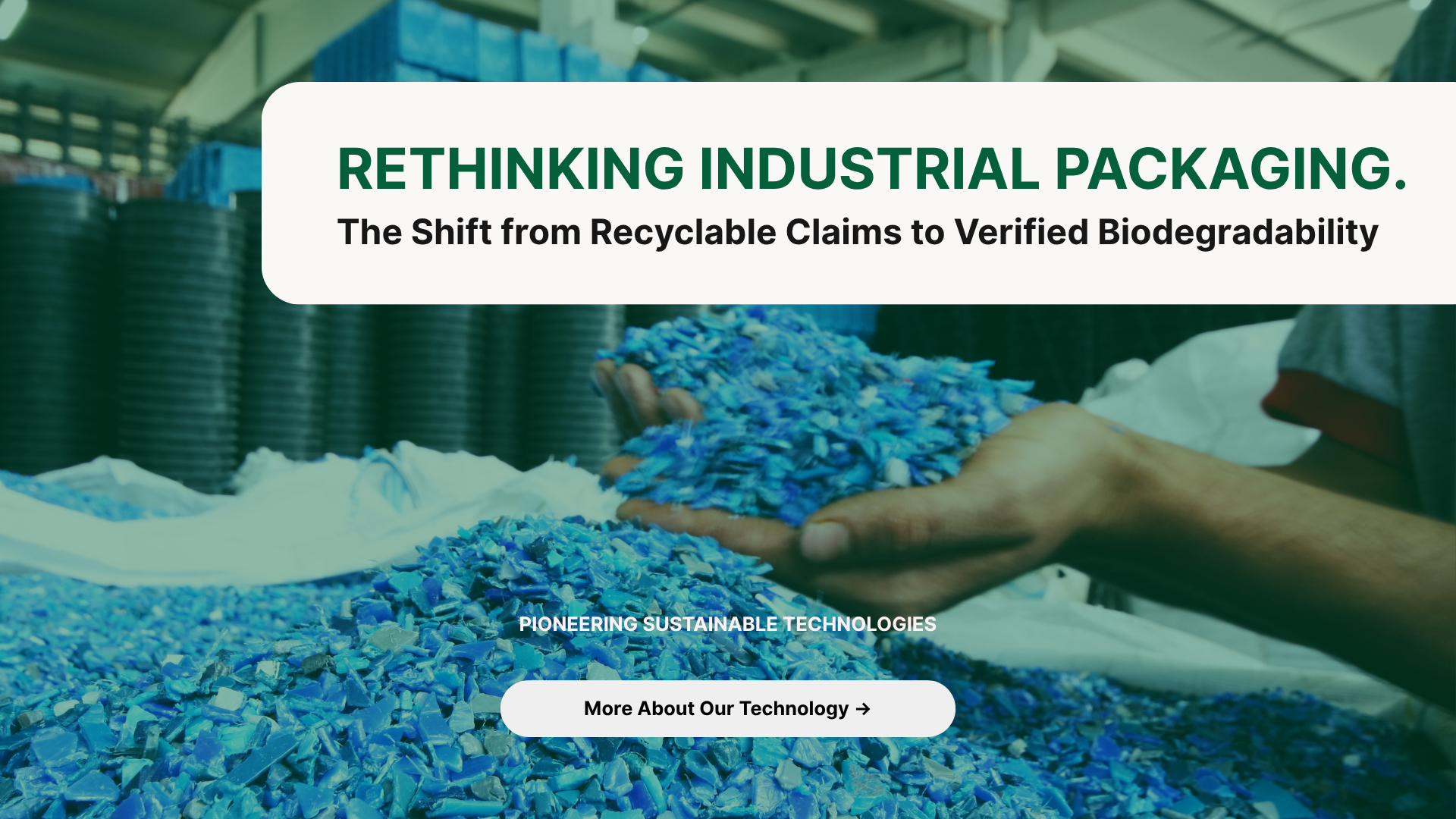
Why recyclable is no longer enough?
For decades, “recyclable” has served as the dominant sustainability claim in global packaging. It appeared on bottles, boxes and corporate reports as shorthand for environmental responsibility. However, as recycling systems continue to underperform and evidence of microplastic contamination grows, industry leaders and regulators are acknowledging a crucial truth. Being recyclable does not mean being recycled.
Across industrial supply chains, recyclability is limited by collection access, contamination and economics.
The United Nations Environment Programme estimates that less than 10% of all plastic produced since the 1950s has been effectively recycled. The rest has been incinerated, landfilled or lost to the environment. This reality has forced a global rethink. Verified biodegradability is emerging as the new benchmark for packaging integrity.
The failure of recyclability as a complete sustainability metric.
Recycling relies on consistent collection, clean separation and stable markets for recovered material. Industrial packaging often fails these conditions. Grease, ink, food residues and multilayer laminates make recovery difficult. Even when collected, downcycling is common. High quality polymers become lower grade products, eventually entering landfill anyway.
In Australia, the collapse of several national soft plastic programs highlighted how fragile recycling networks can be when built on voluntary collection. The result is clear. Recycling alone cannot handle the scale of industrial packaging waste.
A “recyclable” label on packaging is therefore only theoretical. It implies potential recovery, not actual recovery. This distinction matters for ESG reporting, legal compliance and investor scrutiny. Without verifiable end-of-life data, recyclable claims risk being treated as greenwashing.
Verified biodegradability. The next measurable standard.
Verified biodegradability means that a material has been tested under realistic conditions to demonstrate full biological breakdown into non-toxic components such as carbon dioxide, water and biomass. Certification bodies verify that no microplastics or harmful residues remain. This makes biodegradation a measurable and transparent outcome rather than a vague aspiration.
The European Committee for Standardization and the American Society for Testing and Materials have both developed biodegradation standards for industrial packaging. These include specific timeframes and environmental conditions such as temperature, humidity and microbial activity. Independent laboratories measure weight loss, gas release and residue analysis to confirm performance.
This framework provides manufacturers and regulators with quantifiable data. It allows packaging to be compared objectively, much like fuel efficiency or emission standards in transport.
The role of depolymerisation technology in closing the loop.
Depolymerisation is a controlled process that enables plastic to be broken down into its base monomers, allowing natural microbial digestion. Unlike simple fragmentation, which produces microplastics, depolymerisation changes the molecular structure of the material so that it is recognised by microbes as food.
The Greener Tech Group’s The Eco Bottle and similar biodegradable HDPE and LDPE applications use a proprietary organic additive to trigger this process once exposed to landfill conditions. Independent tests confirm that the material decomposes fully, leaving no microplastic residue or methane emissions. The process ends with the creation of a nutrient-rich organic material that behaves like fertiliser within soil ecosystems.
For industries, this represents a shift from symbolic recycling efforts to proven environmental performance.
Governments are tightening definitions of environmental claims. The European Union’s Green Claims Directive, adopted in 2024, requires any environmental statement to be supported by verifiable evidence. Claims such as “eco-friendly,” “green,” or “recyclable” must now include measurable proof or independent certification.
In Australia, the ACCC has issued updated guidance on green marketing under the Australian Consumer Law. Companies must substantiate environmental claims with transparent documentation. Unsupported recyclability statements are no longer considered compliant.
Internationally, ESG frameworks are converging around the need for full life cycle assessment and end-of-life verification. Under these standards, packaging that is merely “recyclable” does not meet the threshold for environmental or financial reporting.
Packaging that is “biodegradable with certified verification” does.
Industry standards and certification pathways.
The following international and regional certifications are shaping best practice for biodegradable packaging:
- ASTM D5511 and D5338: Standard methods for determining anaerobic and aerobic biodegradation of plastic materials.
- EN 13432: European standard for compostable and biodegradable packaging materials.
- ISO 17088: International standard for specifications of compostable plastics.
- AS 5810 and AS 4736: Australian standards for biodegradability under industrial and home composting conditions.
Manufacturers seeking credibility must provide documentation from recognised third-party laboratories. These certifications confirm that a material’s biodegradation is measurable, replicable and free from harmful residues.
The Australian opportunity.
Australia has the technical capacity, research infrastructure and regulatory momentum to lead in verified biodegradable packaging. The national plastics plan highlights the need to reduce landfill persistence and improve material transparency. Local innovation in depolymerisation and certified biodegradable HDPE production can anchor a new export category.
By aligning with European verification frameworks, Australian companies can supply compliant packaging to global markets while improving domestic landfill outcomes. Verified biodegradability becomes both a compliance advantage and an export credential.
The future of packaging is measurable.
The global conversation on packaging sustainability is changing. “Recyclable” is no longer sufficient. Industries now demand materials that demonstrate complete, verifiable breakdown without environmental harm. Verified biodegradable packaging meets this need with data, certification and traceable performance.
Depolymerisation technology allows industrial packaging to decompose safely, removing microplastic risk and methane emissions. Investors, regulators and consumers are all moving toward measurable outcomes. For manufacturers, the shift from recyclable claims to verified biodegradability is not just a trend. It is the new definition of integrity.
Key Summary
✓ Recyclable does not mean recycled. Verified biodegradability provides measurable results.
✓ Depolymerisation allows full breakdown without microplastic residues or methane emissions.
✓ Regulations and ESG standards now require verified, not assumed, environmental performance.
✓ Certified biodegradable packaging aligns with circular economy principles and landfill safety.
✓ Investors reward verifiable claims with higher ESG scores and lower capital risk.
✓ Australia can lead in verified biodegradable HDPE and LDPE production and export.
✓ Verified biodegradability converts sustainability from narrative to measurable action.
References
European Commission. Green Claims Directive 2023.
https://environment.ec.europa.eu/publications/proposal-directive-green-claims_en
United Nations Environment Programme. Global Waste Management Outlook 2024.
https://www.unep.org/resources/global-waste-management-outlook-2024
Australian Competition and Consumer Commission. Environmental and sustainability claims.
https://www.accc.gov.au/consumers/advertising-and-promotions/environmental-and-sustainability-claims
Morningstar. Global ESG Fund Landscape Report 2024.
https://www.morningstar.com/sustainable-investing/global-esg-fund-flows-increase-q4
Food and Agriculture Organization of the United Nations. Circular Economy and Plastics in Agriculture.
https://openknowledge.fao.org/server/api/core/bitstreams/0aa558d4-57c7-498d-87f7-b9e37577882f/content/src/html/exploring-circular-economy-through-plastic-recycling.html
The Greener Tech Group. Eco Bottle Technology Brief 2025. Internal publication.