
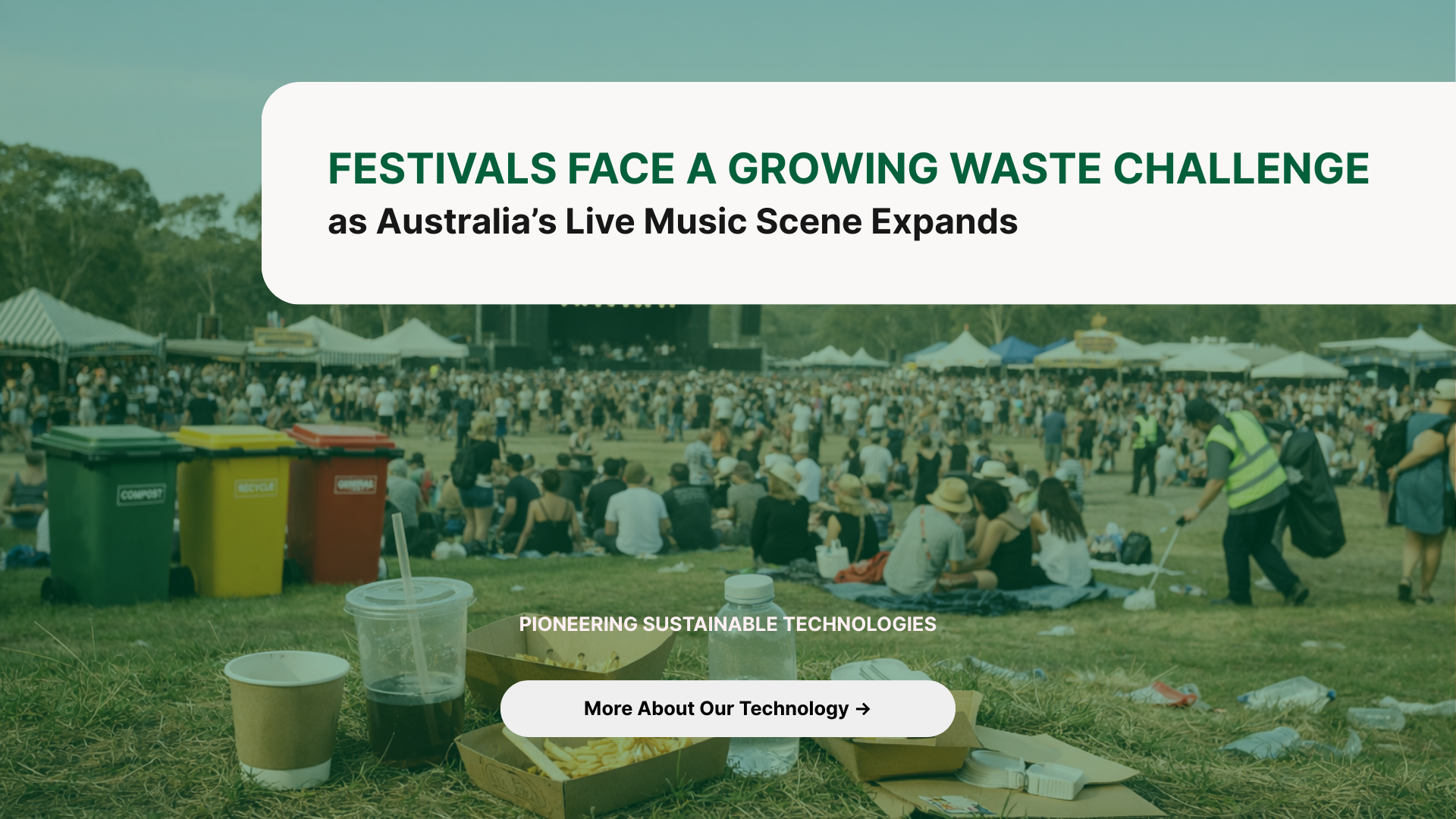
Australia’s live music and festival sector is entering a new phase of growth. Major events are returning to full capacity, new festivals are emerging across metropolitan and regional areas, and attendance levels are climbing. While this expansion brings cultural and economic benefits, it also introduces a growing environmental challenge that organisers can no longer treat as secondary. Waste generation at festivals is increasing at a pace that existing systems struggle to manage.
Recent reporting by Ausleisure highlights how waste has become one of the most significant operational risks for festivals. High volumes of single use packaging, short consumption windows and limited recovery infrastructure create conditions where large quantities of waste are sent directly to landfill. As regulation tightens and community expectations rise, festival waste is becoming a determining factor in event approvals, licensing and long term viability.
This article examines why festival waste is escalating, what makes it uniquely difficult to manage, how policy and public pressure are changing expectations, and why packaging choices are now central to the future of live music events in Australia.
The scale of festival growth and consumption
Australia’s festival landscape has rebounded strongly. Large scale music festivals attract tens of thousands of attendees over short periods, often concentrated into 2 or 3 days. Food and beverage consumption peaks sharply during these events. Each attendee may purchase multiple drinks, meals and snacks per day, all of which require packaging.
This creates a waste profile unlike that of households or permanent venues. Consumption is intense, rapid and spatially concentrated. Bins fill quickly. Sorting becomes inconsistent. Packaging is often discarded wherever people are standing rather than at designated points.
As attendance grows, so does the waste burden. Organisers face rising costs for bin hire, waste contractors, transport and disposal. These costs are compounded when recycling streams are contaminated and charged at landfill rates.
Why festival waste is so difficult to manage
Festival waste presents several structural challenges:
- First, contamination rates are high. Food residue, liquids and mixed materials reduce the quality of recyclable waste. Even well intentioned attendees often dispose of items incorrectly due to confusion or convenience.
- Second, waste is generated in bursts. Peak times overwhelm bin capacity and staff resources. Overflowing bins increase litter and environmental impact.
- Third, festivals often take place in temporary or regional locations where waste processing infrastructure is limited. Transporting waste long distances adds cost and emissions.
- Fourth, many packaging items used at festivals are small and lightweight. Items such as lids, cutlery, sachets and wrappers are easily lost or trampled. These items are also among the hardest to recycle and are frequently targeted under plastic reduction policies.
Together, these factors explain why festivals generate large waste volumes with low recovery rates.
Regulatory and community pressure is increasing
Festival organisers now operate under heightened scrutiny from councils, regulators and local communities. Waste management plans are a standard requirement for event approvals. These plans must demonstrate how waste will be minimised, managed and removed without environmental harm.
Australia is also moving toward banning hard to recycle plastics by 2026. Items commonly used at festivals such as small plastic packaging, condiment sachets and composite food containers are among those identified for phase out under national and state policies.
Communities hosting festivals are increasingly vocal about environmental impact. Visible waste left behind after events damages trust and can jeopardise future approvals. For councils, waste outcomes have become a measurable indicator of whether an event is responsibly managed.
In this context, waste is no longer an operational detail. It is a licensing and reputational issue.
The financial cost of poor waste outcomes
Waste management is now a material cost for festivals. Disposal fees, labour, compliance reporting and infrastructure all add up. As landfill levies rise, the cost of sending waste to landfill increases year on year.
Attempts to recover value through post event sorting have limited success. Once materials are mixed and contaminated, recovery rates drop sharply. Labour costs often exceed environmental benefit.
As a result, organisers are shifting focus from waste cleanup to waste prevention.
Why packaging choices are now central
Packaging is one of the few variables that organisers can control directly. While attendee behaviour is unpredictable, packaging specifications can be mandated.
Single use packaging remains common due to hygiene, speed and logistics. However not all packaging materials carry the same environmental burden.
Hard to recycle plastics persist in the environment and contribute to microplastic pollution. Paper products with plastic linings create composite waste that is difficult to process. Small plastic items are easily lost and rarely recovered.
By contrast, verified biodegradable and compostable materials offer different end of life outcomes when managed correctly. By changing packaging requirements for vendors, festivals can significantly reduce landfill volumes without requiring major behaviour change from attendees.
The importance of material verification
Not all products marketed as sustainable perform as claimed. CSIRO research has identified widespread confusion around bioplastics and biodegradable materials in Australia. Some products break into fragments rather than fully biodegrading. Others require industrial conditions that are not available at festival sites.
For organisers, using unverified materials creates compliance risk. Councils and regulators increasingly expect evidence of material performance rather than marketing claims.
Material verification provides confidence. It allows organisers to demonstrate that packaging choices align with environmental objectives and regulatory expectations. This shift mirrors broader changes in packaging policy across Australia.
Beverage packaging as a major waste stream
Beverage containers are among the largest contributors to festival waste. Bottled water, soft drinks and alcoholic beverages are consumed continuously throughout events.
Plastic bottles are particularly problematic. Although technically recyclable, recovery rates at festivals are low due to contamination and disposal behaviour. Bottles left on the ground are easily damaged and often end up in landfill.
Scientific research has also raised concerns about microplastics released from plastic bottles into drinking water. While festivals are primarily focused on waste, health considerations are increasingly part of the sustainability conversation.
Reducing reliance on conventional plastic bottles or switching to verified biodegradable alternatives can significantly improve waste outcomes.
The Eco Bottle and enzyme based solutions in festival settings
As festivals search for practical solutions that do not compromise safety or logistics, enzyme based biodegradable packaging is gaining attention. One example is The Eco Bottle, a biodegradable bottled water solution designed to address the long term environmental behaviour of plastic.
Conventional plastic bottles are engineered for durability. Once discarded they persist in landfill and fragment into microplastics over time. This creates long term environmental impact that is difficult to reverse.
The Eco Bottle integrates an enzyme within the plastic structure. This enzyme remains inactive during the product’s use phase, maintaining strength and performance. When the bottle enters suitable disposal environments such as landfill and is exposed to moisture and heat, the enzyme activates and begins breaking down the polymer at a molecular level. This enables full biodegradation rather than fragmentation into microplastics.
For festivals, this offers a practical advantage. Bottled water remains a necessity for hydration, safety and accessibility. Eliminating bottles entirely is often not feasible. Using bottles that can biodegrade without generating microplastics supports the intent of plastic reduction policies while maintaining operational efficiency.
Because enzyme driven biodegradation can be scientifically tested and verified, solutions like The Eco Bottle also align with material verification requirements. This transparency is increasingly important for councils and sponsors assessing environmental performance.
The role of councils and community trust
Festivals depend on community support to operate year after year. Waste is one of the most visible indicators of whether an event respects its surroundings.
Councils increasingly use waste outcomes as a benchmark for responsible event management. Festivals that demonstrate strong waste reduction and material responsibility are better positioned to secure future approvals.
Conversely, poor waste performance can result in stricter conditions or refusal of permits. Packaging choices therefore have direct implications for long term viability.
Why the challenge will intensify
Australia’s live music sector is expected to continue expanding. At the same time, regulatory standards are tightening and public tolerance for waste is declining.
This creates a convergence of pressures. More people, more consumption and less room for environmental failure.
Festivals that fail to adapt risk higher costs, compliance issues and reputational damage.
Conclusion
Australia’s expanding live music scene brings energy, culture and economic value. It also brings responsibility. Waste is now one of the defining challenges facing festivals.
Recent reporting confirms that existing systems are under strain. Packaging choices play a central role in determining waste outcomes. By addressing waste at the source, adopting verified materials and aligning with national plastic reduction policies, festivals can continue to grow without leaving an expanding environmental footprint.
Solutions such as verified biodegradable packaging and enzyme based bottles offer a pathway forward. They allow essential services to continue while reducing long term impact.
The future of Australian festivals will be shaped not only by who performs on stage, but by how responsibly events manage what remains when the music stops.
Key Summary
• Australia’s live music festivals are expanding rapidly
• Waste volumes are rising faster than infrastructure can manage
• Festival waste is highly contaminated and difficult to recycle
• Councils are increasing waste and sustainability requirements
• Beverage packaging is a major waste contributor
• Packaging choices directly influence compliance and approvals
• Verified biodegradable materials reduce long term impact
• The Eco Bottle offers a practical solution for festival hydration
• Waste prevention is becoming essential for festival viability
References
AUSLEISURE.
Festivals face growing waste challenge as Australia’s live music scene expands. Sydney: Ausleisure, 2025. Available at: https://www.ausleisure.com.au/news/festivals-face-growing-waste-challenge-as-australias-live-music-scene-expands. Accessed on: 31 Dec. 2025.
AUSTRALIAN GOVERNMENT. Department of Climate Change, Energy, the Environment and Water.
Australian Plastics Flows and Fates Reporting 2023 to 2024. Canberra: DCCEEW, 2024. Available at: https://www.dcceew.gov.au/environment/protection/waste/plastics-and-packaging/australian-plastic-flows-fates-reporting. Accessed on: 31 Dec. 2025.
AUSTRALIAN GOVERNMENT. Department of Climate Change, Energy, the Environment and Water.
National Roadmap for Problematic and Unnecessary Plastics. Canberra: DCCEEW, 2021. Available at: https://www.dcceew.gov.au/environment/protection/waste/plastics-and-packaging. Accessed on: 31 Dec. 2025.
CSIRO. Commonwealth Scientific and Industrial Research Organisation.
The State of Bioplastics in Australia. Canberra: CSIRO, 2024. Available at: https://www.csiro.au/en/news/all/news/2024/december/csiro-report-reveals-the-state-of-bioplastics-in-australia. Accessed on: 31 Dec. 2025.
EUROPEAN COMMISSION.
EU Strategy for Sustainable and Circular Textiles and Packaging. Brussels: European Commission, 2023. Available at: https://ec.europa.eu. Accessed on: 31 Dec. 2025.