
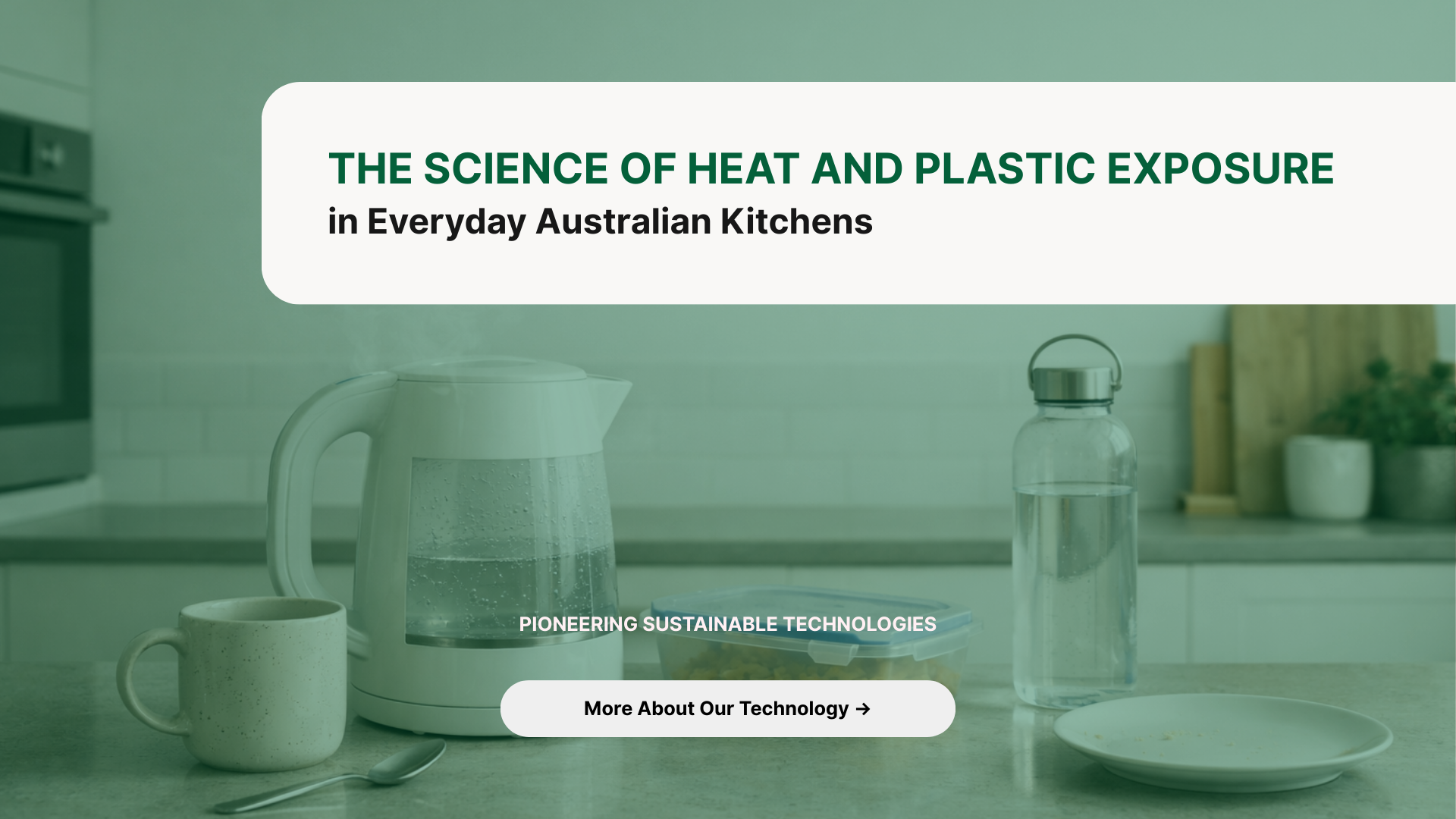
Plastic is present in nearly every Australian kitchen. From electric kettles and food containers to takeaway packaging and microwave safe products, plastic has become embedded in daily food preparation habits. For decades these materials were considered safe when used according to manufacturer instructions. However new scientific research is changing this assumption.
Recent studies show that heat plays a critical role in the release of microplastics and nanoplastics from plastic products. When plastic is exposed to high temperatures through boiling water, microwaving or contact with hot food, microscopic particles can be released into what we consume. These particles are invisible, tasteless and impossible to detect without laboratory analysis.
This article examines what science now confirms about heat and plastic exposure in kitchens. It explains how microplastics are released, which kitchen items pose the highest risk, what verified health research shows, and why this issue matters for Australian households, regulators and food safety standards.
Why heat changes how plastic behaves
Plastic polymers are designed to be durable, flexible and resistant to everyday wear. However heat introduces stress at a molecular level. When plastic is heated, polymer chains expand and contract. Over repeated cycles this causes surface degradation, micro cracking and particle shedding.
Scientific research confirms that plastic does not need to melt to release particles. Temperatures commonly reached in kitchens such as 90 to 100 degrees Celsius are sufficient to cause microplastic and nanoplastic release from many consumer plastics.
This process is physical rather than chemical. It does not rely on additives leaching or chemical breakdown. Instead microscopic fragments detach from the plastic surface and enter surrounding food or water.
Kitchen items most associated with heat driven plastic release
Plastic electric kettles
One of the most studied household items is the plastic electric kettle. Many kettles contain plastic inner linings or base plates that come into direct contact with boiling water.
A peer reviewed study published in Environmental Science and Technology in 2024 demonstrated that boiling water in plastic kettles released millions of microplastic and nanoplastic particles per litre. The majority of particles detected were nanoplastics smaller than 1 micrometre.
The researchers confirmed that the polymers detected matched those used in kettle construction, establishing the kettle as the source. Although the highest release occurred during early uses, continued release was observed after repeated boiling cycles.
Given the frequency of kettle use in Australian homes, this represents a consistent daily exposure pathway.
Microwave safe plastic containers
Plastic containers labelled as microwave safe are widely used for reheating food. While these products meet current food contact standards, scientific studies show that microwaving accelerates microplastic release.
Heat combined with moisture and food acidity increases stress on plastic surfaces. Research published in 2023 and 2024 confirmed that microwaving plastic containers resulted in measurable microplastic release into food simulants.
Importantly, the term microwave safe refers to structural integrity and chemical migration limits. It does not address microplastic particle shedding, which is not yet regulated.
Takeaway food containers and hot packaging
Single use takeaway containers often come into contact with hot food immediately after cooking. These containers are commonly made from polypropylene or polystyrene.
Scientific evidence confirms that hot food increases microplastic release compared to cold contact. Oils and fats further accelerate this process by interacting with plastic surfaces.
For Australians who frequently consume takeaway meals, this represents another repeated exposure source.
Plastic utensils and kitchen tools
Spatulas, ladles and stirring tools made from plastic are regularly exposed to heat during cooking. Friction combined with heat can cause surface wear and microplastic release.
Although data on utensils is more limited than for kettles and containers, studies confirm that mechanical stress increases particle shedding from plastic tools.
What verified health research shows
Microplastics and nanoplastics were once considered an environmental issue only. Medical research now confirms human exposure and internal accumulation.
In 2024 the New England Journal of Medicine published a study identifying microplastics in human arterial tissue. Patients with higher concentrations had increased risk of cardiovascular events including heart attack and stroke.
This study confirmed three critical points. Microplastics can enter the human body, they can persist in tissue, and their presence is associated with measurable health outcomes.
Nanoplastics present an additional concern. Due to their size they can cross biological barriers including the intestinal lining. Research from National Institutes of Health and Columbia University found that bottled water contained an average of 240000 plastic particles per litre, most of them nanoplastics.
While no single study isolates kitchen heat exposure as the sole cause of these findings, the evidence confirms that drinking water and food are major exposure pathways.
Practical steps supported by evidence
Based on verified science, several practical actions can reduce exposure.
Using stainless steel or glass kettles eliminates direct plastic contact with boiling water. Allowing a new plastic kettle to run several initial boil cycles and discarding that water may reduce early particle release.
Avoiding microwaving food in plastic containers reduces heat driven shedding. Transferring food to ceramic or glass before reheating is a simple alternative.
Minimising contact between hot food and plastic packaging where possible can also reduce exposure.
These steps do not eliminate microplastics entirely but reduce identifiable and avoidable sources.
Conclusion
Scientific research now confirms that heat plays a significant role in microplastic and nanoplastic release from everyday kitchen plastics. Items such as electric kettles, microwave containers and hot takeaway packaging are verified exposure pathways.
Medical evidence confirms that microplastics can enter the human body and are associated with adverse health outcomes. While research continues, the direction is clear.
For Australian households this issue highlights that plastic exposure is not limited to waste and pollution. It also occurs during routine food and drink preparation.
Reducing unnecessary plastic contact with heat is a practical step toward lowering exposure. As science, policy and consumer awareness evolve, kitchens that minimise plastic use under heat are likely to become the new standard.
Key Summary
- Heat accelerates microplastic release from plastic kitchen items
- Plastic kettles can release millions of particles per litre
- Microwaving plastic containers increases particle shedding
- Medical studies confirm microplastics in human arteries
- Nanoplastics can cross biological barriers
- Kitchen habits contribute to cumulative exposure
- Stainless steel and glass reduce plastic contact with heat
- Regulation has not yet caught up with science
References
LIU, J.; ZHANG, Y.; LI, X.; et al.
Release of microplastics and nanoplastics from plastic electric kettles during boiling water use. Environmental Science and Technology, Washington, v. 58, n. 5, p. 3214–3223, 2024. DOI: 10.1021/acs.est.3c08553.
HERNANDEZ, L. M.; YOUSEFI, N.; TUFENKJI, N.
Are there nanoplastics in your personal care products? Environmental Science and Technology, Washington, v. 51, n. 21, p. 12397–12405, 2017.
THE NEW ENGLAND JOURNAL OF MEDICINE.
Microplastics and nanoplastics in human arteries. New England Journal of Medicine, Massachusetts, v. 390, n. 6, p. 487–495, 2024. Available at: https://www.nejm.org
Accessed on: 30 Dec. 2025.
KOELMANS, A. A.; NOR, N. H. M.; HERMANNSEN, L.; et al.
Microplastics in freshwaters and drinking water. Water Research, Oxford, v. 155, p. 410–422, 2019.
OCCUPATIONAL SAFETY AND HEALTH ADMINISTRATION.
Polypropylene material properties and thermal behaviour. Washington: OSHA, 2022. Available at: https://www.osha.gov
Accessed on: 30 Dec. 2025.
COLUMBIA UNIVERSITY; NATIONAL INSTITUTES OF HEALTH.
Nanoplastics in bottled water. New York: Columbia University, 2024. Available at: https://www.nih.gov
Accessed on: 30 Dec. 2025.
AUSTRALIAN GOVERNMENT. Department of Climate Change, Energy, the Environment and Water.
National Plastics Plan 2021. Canberra: DCCEEW, 2021. Available at: https://www.dcceew.gov.au
Accessed on: 30 Dec. 2025.