
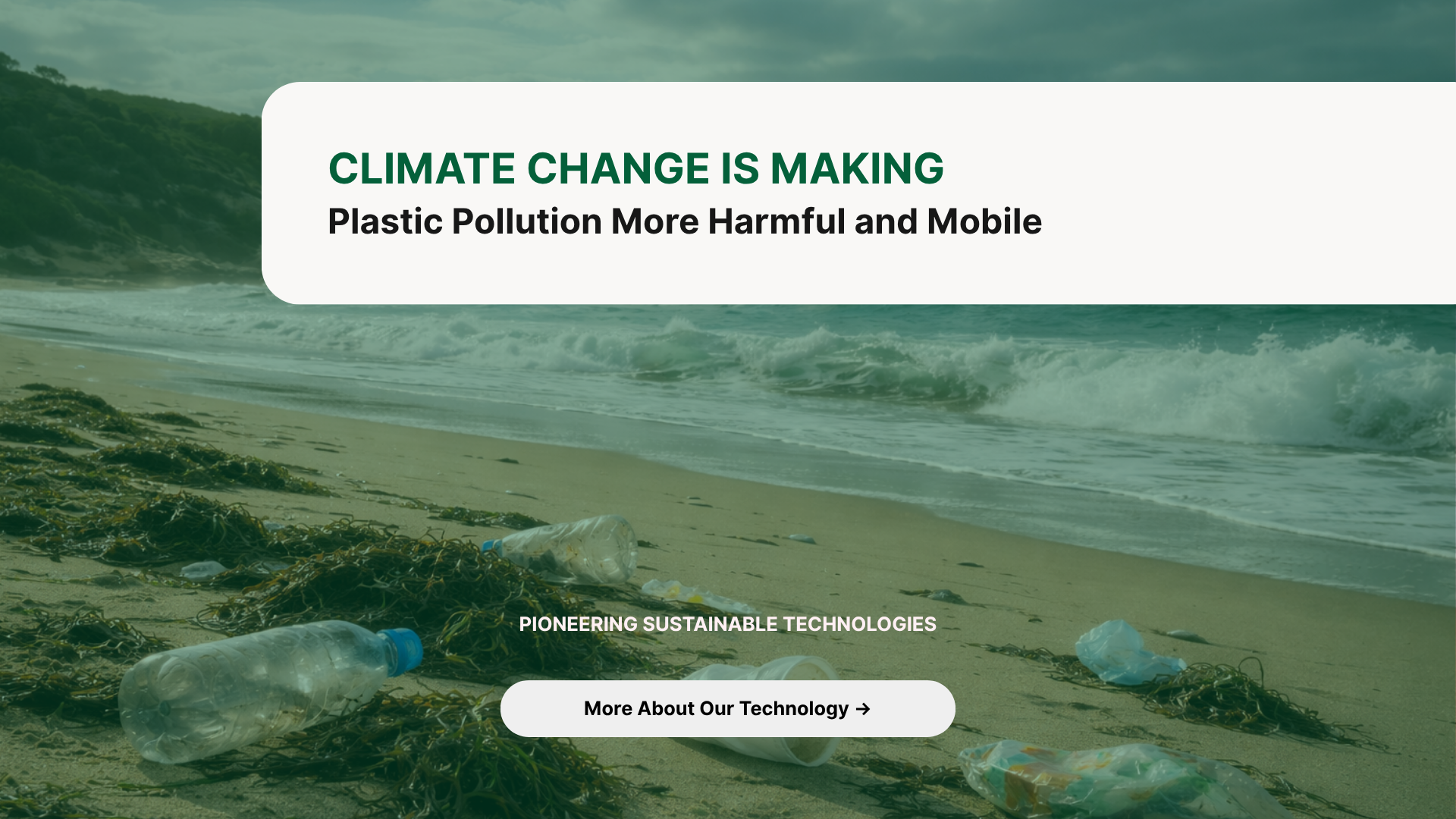
Plastic pollution has traditionally been framed as a waste management issue. The focus has been on reducing litter, improving recycling rates and managing landfill volumes. However recent research highlights a more complex and concerning reality. Climate change is actively transforming how plastic behaves in the environment, making it more mobile, persistent and harmful.
This shift represents a critical evolution in how plastic pollution must be understood. It is no longer a static problem confined to specific locations. Instead it is becoming a dynamic and climate sensitive threat that moves through ecosystems, interacts with biological systems and amplifies environmental risk.
This article explores the latest scientific insights, explains how climate change is altering plastic behaviour, and outlines what this means for Australia’s environmental policy, packaging systems and long term sustainability strategy.
Plastic pollution and climate change are interconnected systems
Plastic pollution and climate change are often treated as separate global challenges. In reality they share the same underlying drivers. Most plastics are produced from fossil fuels, and greenhouse gases are emitted throughout their lifecycle, from extraction to disposal.
As plastic production has increased globally, so too have emissions associated with its manufacture and waste management. At the same time, climate change is altering environmental conditions in ways that directly influence how plastic behaves after it enters ecosystems.
Recent analysis published through the World Economic Forum highlights that climate change is reshaping plastic pollution by changing temperature, weather patterns and Earth system processes.
This connection creates a feedback loop. Plastic production contributes to climate change, and climate change in turn worsens the impact of plastic pollution.
Why plastics are becoming more mobile
One of the most significant findings is that climate change is increasing the mobility of plastic pollution.
Changes in wind patterns, ocean currents and extreme weather events are redistributing plastic across greater distances. Storms, floods and rising sea levels transport plastic waste from land into rivers and oceans at higher rates.
Research shows that plastic is no longer confined to where it is discarded. It is now moving through land, water, air and even ice systems.
This increased mobility has several consequences. It spreads pollution into previously unaffected ecosystems. It makes tracking and cleanup more difficult. It also increases the likelihood that plastic will enter food systems and human environments.
For Australia, this is particularly relevant given the country’s extensive coastline and vulnerability to extreme weather events.
The role of rising temperatures
Temperature plays a critical role in how plastic degrades. As global temperatures rise, plastics are exposed to more intense heat and sunlight. This accelerates physical breakdown and fragmentation.
Plastics do not biodegrade in the traditional sense. Instead they fragment into smaller particles known as microplastics and nanoplastics. Warmer conditions increase the rate of this fragmentation process.
This means that climate change is effectively increasing the speed at which plastic pollution becomes biologically available. Smaller particles are more easily ingested by wildlife and more difficult to remove from the environment.
Increased persistence and environmental interaction
Climate change is not only making plastics more mobile. It is also altering how they interact with ecosystems.
Microplastics can absorb and transport chemical pollutants. As they move through water and soil, they carry these substances into new environments. This creates complex interactions between plastic particles and biological systems.
Research indicates that plastic pollution is now a dynamic environmental stressor that interacts with living systems across multiple scales.
This includes marine ecosystems, agricultural soils and atmospheric systems. Microplastics have been detected in remote regions, demonstrating the extent of their spread.
Extreme weather events as a multiplier
Extreme weather events are becoming more frequent and intense due to climate change. These events act as multipliers for plastic pollution.
Floods can mobilise large volumes of waste from urban areas into waterways. Storm surges can redistribute marine plastic across coastlines. Drought conditions can concentrate pollutants in specific areas.
These processes increase both the scale and unpredictability of plastic pollution. Waste that might otherwise remain contained in landfill or local environments can be redistributed across entire regions.
For Australia, where extreme weather events such as floods and bushfires are increasing, this dynamic is particularly important.
Implications for human exposure
As plastic becomes more mobile and fragmented, human exposure pathways expand. Microplastics can enter the body through ingestion, inhalation and potentially through water systems.
Plastic particles have already been detected in air, food and drinking water. Increased mobility means that exposure is no longer limited to heavily polluted areas.
[Inference] As climate change continues to redistribute plastic across environments, the likelihood of consistent low level human exposure is expected to increase.
This shifts plastic pollution from an environmental issue to a public health consideration.
Why current policy frameworks are not enough
Most existing plastic policies focus on waste reduction, recycling and bans on specific items. While these measures are important, they do not fully address the climate driven dynamics of plastic pollution.
Traditional policy assumes that plastic remains relatively stable after disposal. The new evidence challenges this assumption.
If plastic is moving across systems and interacting with climate processes, then policy responses must also evolve. This includes integrating climate considerations into plastic regulation.
The World Economic Forum analysis emphasises that plastic policy and climate policy should not be treated separately. They must be aligned as part of a single strategy.
Implications for Australia
Australia is already implementing measures to reduce plastic waste, including bans on hard to recycle items by 2026. These policies are an important step forward.
However climate driven changes in plastic behaviour suggest that further action may be required.
This could include:
• stronger controls on plastic production and material selection
• improved monitoring of microplastic movement across ecosystems
• integration of climate modelling into waste management strategies
• increased focus on materials that do not persist or fragment
Australia’s geographic position and exposure to climate variability make it particularly vulnerable to these dynamics.
The role of material innovation
As the understanding of plastic pollution evolves, so too does the need for innovation in materials.
Solutions that focus only on recyclability may not be sufficient if materials continue to fragment and persist in the environment. Greater emphasis is being placed on materials that can demonstrate safe end of life behaviour.
This includes biodegradable technologies, alternative materials and improved product design.
However innovation must be supported by verification. Materials must be tested under real world conditions to ensure they perform as expected.
A shift in how the problem is defined
The key takeaway from recent research is that plastic pollution is no longer a static waste issue. It is a dynamic environmental system influenced by climate conditions.
This changes how the problem must be approached. Solutions must consider movement, transformation and interaction across ecosystems.
It also reinforces the need for global coordination. Plastic pollution does not respect borders, and climate processes amplify its reach.
Conclusion
Climate change is fundamentally altering the behaviour of plastic pollution. Rising temperatures, shifting weather patterns and extreme events are making plastics more mobile, persistent and harmful.
This creates a more complex and interconnected environmental challenge. Addressing plastic pollution now requires integrating climate science, material innovation and policy alignment.
For Australia, the implications are clear. Existing waste reduction strategies must be complemented by broader approaches that consider how plastic interacts with a changing climate.
As science continues to evolve, so too must the systems designed to manage one of the most persistent materials in the modern world.
Key Summary
• Climate change is increasing the mobility of plastic pollution
• Plastics are now moving through land, water, air and ice systems
• Rising temperatures accelerate fragmentation into microplastics
• Extreme weather events redistribute plastic across ecosystems
• Plastic pollution and climate change are interconnected systems
• Human exposure pathways are expanding
• Current policies focus too narrowly on waste management
• Material innovation and verification are becoming critical
• Integrated climate and plastic strategies are required
References
WORLD ECONOMIC FORUM.
How climate change is reshaping the global plastic pollution crisis. Geneva: WEF, 2026. Available at: https://www.weforum.org/stories/2026/02/climate-change-reshaping-global-plastic-pollution-crisis/. Accessed on: 26 Mar. 2026.
KELLY, F. J.; FUSSELL, J. C.
Climate driven changes in plastic pollution behaviour. Frontiers in Science, 2026.
WORLD ECONOMIC FORUM.
Why solving plastic pollution is a major climate opportunity. Geneva: WEF, 2025. Available at: https://www.weforum.org. Accessed on: 26 Mar. 2026.
UNITED NATIONS ENVIRONMENT PROGRAMME.
UN roadmap outlines solutions to cut global plastic pollution. Nairobi: UNEP, 2023. Available at: https://www.unep.org/news-and-stories/press-release/un-roadmap-outlines-solutions-cut-global-plastic-pollution Accessed on: 26 Mar. 2026.