
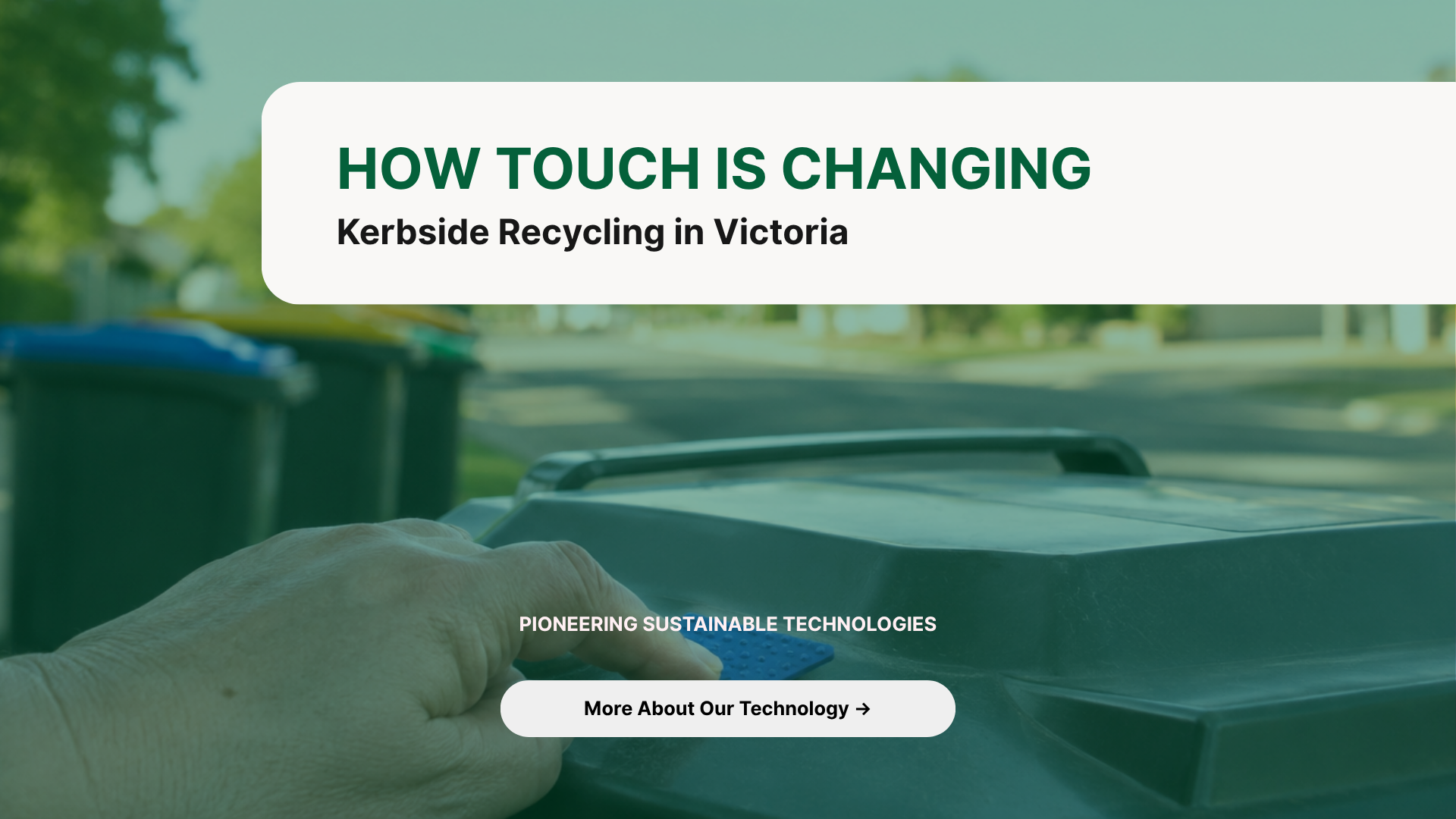
A small moulded shape glued to the lid of a kerbside bin might seem like a minor detail. For hundreds of thousands of Australians who are blind or have low vision, it represents the difference between independent participation in waste management and relying entirely on another person to sort correctly. Bass Coast Shire Council in Victoria has introduced a tactile bin symbol program that is quietly addressing both an accessibility gap and a broader waste system problem, and doing so with a material that reflects the circular economy logic the initiative promotes.
A Low-Tech Solution to a Systemic Barrier
The tactile bin symbols are small, moulded shapes attached to kerbside bin lids, designed to help residents tell the difference between recycling, food and garden organics, and general rubbish by using touch instead of sight. The symbols are available for free to the whole community and are simple to install, requiring a small amount of glue, with instructions provided.
The concept is straightforward. Each shape corresponds to a different bin type. A square represents the red-lid general rubbish bin. The assignment of distinct geometric forms to each waste stream means that a resident who cannot read a bin label or distinguish between lid colours can still sort correctly, confidently and without assistance.
Initiatives such as the tactile bin symbols are a direct response to feedback from people living with disabilities, who have highlighted how everyday tasks such as sorting waste can become barriers. This feedback-driven design process matters. It reflects a shift from designing for average users and retrofitting for accessibility toward embedding inclusive thinking from the outset.
The Scale of Vision Impairment in Australia
The potential reach of this kind of initiative is substantial. According to a 2015 report, there were 576,000 people who were blind or visually impaired in Australia, and 66,000 people who were totally blind. Vision Australia projected at that time that there were approximately 89,500 people with vision impairment in Victoria alone, with that figure likely to rise to around 138,000 by 2030. More recent projections from academic sources indicate that the number of Australians with vision-related disability is expected to nearly double between 2020 and 2060, driven primarily by an ageing population.
Chronic eye conditions affected 93% of people aged 65 and over in Australia in 2017 and 18, compared with only 12% among people aged 0 to 14. As Australia’s population ages, the number of people who need accessible infrastructure in daily life will continue to grow. Waste sorting is not an edge case. It is a weekly task that every household must perform, and the consequences of getting it wrong extend well beyond the individual.
Contamination Is Not a Minor Issue
Australia’s recycling system faces a persistent contamination problem. When the wrong materials enter the recycling stream, the economic and environmental costs multiply quickly. The national resource recovery rate in 2022 to 2023 was 66%, but the recovery rate for plastics was the lowest of any material category at only 12%. One of the principal causes of poor recycling outcomes at the household level is incorrect sorting, which generates contaminated loads that cannot be economically processed.
The use of tactile symbols on domestic waste and recycling bins supports and empowers individuals with vision impairments to identify and differentiate waste bins independently, assisting with sorting and participating in waste management and recycling principles. Central Coast Council in New South Wales has also introduced a tactile sticker program for this reason, noting that the symbols create an inclusive environment, reduce contamination and promote a sustainable environment.
The connection between accessibility and recycling quality is not coincidental. A resident who cannot see bin colours or read printed labels is at higher risk of placing materials in the wrong bin. That contamination then affects the entire load collected from a given street. Reducing sorting errors at the household level, for any reason, improves the integrity of the recycling stream for everyone.
Material Choice Reflects the Initiative’s Ethos
The decision to manufacture the tactile symbols from recycled polypropylene is meaningful beyond symbolism. The symbols are made from recycled polypropylene plastic, aligning with the council’s commitment to sustainability. Polypropylene, commonly used in food containers and packaging, is widely accepted by most Australian councils through kerbside recycling and has a well-established secondary market.
Using recycled polypropylene to help residents sort recycling correctly is an example of closed-loop thinking applied at the product design level. The material itself is a recycled output from the very waste stream the symbols are designed to support. That coherence between the tool and the outcome it aims to achieve gives the initiative an integrity that purely visual or paper-based accessibility aids might lack.
A Scalable Model for Councils Nationally
Bass Coast is not a large metropolitan council. It covers a coastal and rural region in Victoria’s south-east, with a relatively modest population base. The fact that a regional council has developed and deployed an accessible, sustainable and apparently replicable program suggests the barriers to adoption elsewhere are low.
The symbols require no digital infrastructure, no app integration, no ongoing subscription and no specialist installation. They attach with glue and are provided free of charge. For any council managing kerbside waste collection across a mixed demographic, including ageing residents, residents with acquired disability and households where visual impairment is present but not formally registered, the cost of rollout is minimal relative to the potential impact on sorting accuracy and community inclusion.
Australia’s circularity rate was around 4.3% in 2024, lower than the global average of 6.9%, and the government’s Circular Economy Framework sets a goal to double that rate by 2035. Reaching that target will require improvements across every layer of the waste system, from industrial processing to household behaviour. Inclusive design at the kerbside level is not a peripheral concern in that context. It is a practical lever.
Inclusion Is a Waste Management Strategy
The framing of accessibility and environmental performance as separate policy domains has often led to missed opportunities. Programs like Bass Coast’s tactile bin symbols demonstrate that designing for people with disability frequently produces outcomes that benefit the entire waste system.
When waste sorting becomes easier and more independent for residents with low vision, contamination rates fall. When contamination rates fall, recycling economics improve. When recycling economics improve, the case for investment in processing infrastructure strengthens. The chain of effects from a small moulded shape on a bin lid is longer and more commercially relevant than it might first appear.
These small shapes attach to kerbside bin lids, helping residents easily tell the difference between recycling, food and garden organics, and general rubbish by using touch instead of sight. That description applies equally to a resident who is blind by diagnosis and a resident who simply takes their bins out in the dark on a cold morning. Inclusive design at its best makes a system work better for everyone who uses it.
The Greener Tech Group acknowledges Bass Coast Shire Council for demonstrating that practical, sustainable and inclusive solutions do not always require large budgets or complex technology. Sometimes the most effective intervention is a shape you can feel in your hand.
References:
- Waste Management Review Australia. “New waste management initiative for the visually-impaired.” Waste Management Review, 2025. wastemanagementreview.com.au
- Mirage News. “Tactile Bin Symbols Aid Waste Sorting for Low Vision.” Mirage News, 2025. miragenews.com
- Central Coast Council. “Household Waste: Tactile Symbols.” centralcoast.nsw.gov.au
- Victorian Law Reform Commission. “Vision and hearing loss in the Victorian community.” Inclusive Juries Consultation Paper, 2023. lawreform.vic.gov.au
- Australian Institute of Health and Welfare. “Eye health: How common is visual impairment?” AIHW, 2021. aihw.gov.au
- DCCEEW. “Resource recovery and waste materials analysis.” Australian Government Department of Climate Change, Energy, the Environment and Water, 2024. dcceew.gov.au
- Australian Bureau of Statistics. “Circular Economy.” Measuring What Matters, ABS, 2024. abs.gov.au